
Blog
Why Agile Transformations Become Illusions
Most agile transformations rename roles and add ceremonies while leaving the decision rights, reporting lines, and incentives untouched. Here is what actually has to change, and how to tell the difference.
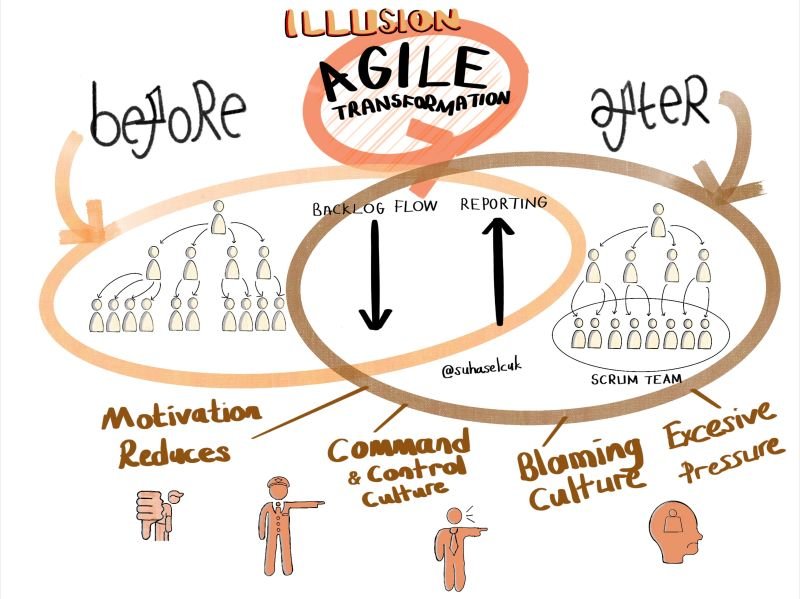
The transformation that changes nothing
Here is a pattern seen in organization after organization. The centralized structure remains exactly as it was: decisions still flow top-down through a command-and-control mechanism, bureaucracy persists, process-focused management still leads operations, long-term master plans are still treated as critical, waterfall project management still dominates delivery, and the silos are usually still standing.
Inside that unchanged structure, the organization stands up Scrum teams and expects productivity to rise.
It does not. Without changing the system, even the leadership style will not change. With traditional structure and traditional management, Agile will fail — not because the practices are wrong, but because the practices were never the thing that needed changing.
This is the illusion: an organization that has adopted the vocabulary of agility without altering a single one of the conditions that produced its previous behaviour.
It is not about the names you give things
There is no point in calling teams "squads", or "tribes", or any other appealing name borrowed from a conference talk. Renaming a team does not redistribute the authority that governs it. Renaming a project manager does not change who signs off on scope.
The main issue to focus on is how information flows within the organization. Specifically:
- workflows — what actually moves, and what waits
- communication structure — who talks to whom, and who never does
- reporting paths — where information is filtered on its way up
- roles, responsibilities, and accountabilities — and whether those three ever coincide
An organization is a system of components, forces, constraints, connections, functions, and the delays between all of them. A lean system has to be established with all of those in view. Redrawing the org chart with new labels changes none of them.
The operating system problem
An analogy that lands with most leadership teams:
Your company gave you a laptop running Windows. Management then decided to improve the user experience, and declared that everyone should act like a MacBook user. But they did not change the operating system on your machine.
You could not pretend to be a MacBook user while actually running Windows. You failed.
And now it is time for "change management" — where you are told that you have to change your behaviour, and your managers set out to understand the reasons for your resistance.
The resistance was never the problem. The resistance was a symptom, and an accurate one. People behave rationally inside the system they are actually in, not the system they have been told to imagine. When a transformation asks for new behaviour without changing the operating system that produces the old behaviour, the failure is designed in from the start — and then attributed to the people.
Psychological safety is an output, not an input
Agile coaches and Scrum Masters ask, repeatedly, how to promote psychological safety. They expect a step-by-step recipe, ideally involving a facilitation technique few people know about.
There isn't one, and the reason matters. When an organization still has rigid hierarchical structures, old-fashioned individual performance evaluation, and command-and-control mechanisms, nothing will encourage psychological safety. A flawed system will never foster it. You cannot facilitate your way out of a structure that punishes candour.
The useful response is not a technique but an analysis: identify the circular causes, examine the relationships between the components of the system, and work out which factors reinforce the current behaviour and which balance it. Safety is what emerges when those factors change. It is not a workshop output.
Context is everything
There cannot be a library of patterns to be applied like a method — not for designing an organization, and not for raising the performance of teams. Nothing can be implemented blindly.
Patterns exist to guide you toward finding your own way and creating your own patterns. There is no one-size-fits-all design, model, or collection of methods, and a framework that promises one is selling the illusion described above in a different wrapper.
Context is everything. Do not invest in theoretical mess without empirical evidence.
This is also why benchmarking another organization's structure so rarely transfers. You are copying the visible artefacts of a system whose constraints, history, market, and people you do not share. The artefacts arrived last in their story. Adopting them first in yours reverses the causality.
Execution is where the system reveals itself
A plan without execution is waste. Strategy without execution is nothing. An idea without execution is a dream. Culture with poor execution is unwieldy.
Execution is also the most honest diagnostic available, because it is where structural constraints stop being theoretical. If work consistently stalls at the same handover, the problem is not the people on either side of it.
To improve execution:
- Establish a lean operating system and minimize bureaucracy. Every approval gate is a delay with a cost; most were added to solve a problem that no longer exists.
- Establish self-managed teams and increase autonomy. Autonomy is not a permission you grant in a memo; it is the authority to decide, held where the information is.
- Remove impediments and eliminate waste at all levels and dimensions — not only inside teams, where it is most visible and least consequential.
- Encourage and support teams to create outcomes at team level, and measure happiness. Output metrics reward motion. Outcome metrics reward judgement.
From linear thinking to systems thinking
What connects all of this is a shift in how the organization is understood. Linear thinking looks for a cause, applies a fix, and expects a proportional result. It is why transformations reach for practices: a practice is a lever you can pull on Monday.
Systems thinking instead:
- sees the whole system rather than the part currently generating complaints
- identifies the circular causes and the leverage loops
- understands how the parts of the system inter-relate
- understands the environment acting on the system
We have been trying to understand Agile for more than twenty years, while the Agile industry has continued to grow. The gap between those two facts is the subject of this article. The industry grew by selling practices, because practices are packageable. The understanding lagged because the thing that actually determines the outcome — the system — is specific to each organization and cannot be sold in a two-day course.
If you want a transformation that holds, start with how decisions are made, how resources flow, how teams coordinate, and how success is measured. Change those, and the practices will follow naturally. Change the practices first, and you will get the illusion.
Suha Selçuk
SysArt Consulting
Continue with related services and guidance
Use these links to connect the article with relevant consulting services and practical guidance.
Questions readers usually ask
What is an illusory agile transformation?
One where the vocabulary changes but the system does not. Teams are renamed squads, stand-ups appear in calendars, and a transformation office reports progress — while decision rights, reporting lines, budgeting cycles, and individual performance targets stay exactly as they were. The organization looks agile in its artefacts and behaves as it always did in its decisions.
How can I tell whether our transformation is real?
Ask where decisions are made. If a team cannot change its own way of working, reprioritize its own backlog, or stop work that is clearly waste without escalating, the authority has not moved. Ceremony attendance tells you nothing; decision latency does.
Why do Scrum teams inside a traditional structure underperform?
Because the team is a component inside a larger system that still rewards utilization, punishes deviation, and routes decisions upward. A team can only be as autonomous as the surrounding structure permits. Changing the component without changing the system produces friction, not throughput.
Can psychological safety be trained into a team?
Not on its own. Psychological safety is an outcome of the system's structure — hierarchy, individual performance evaluation, and command-and-control mechanisms all suppress it regardless of facilitation technique. Fix the structural conditions and safety follows; run workshops without touching them and it does not.
Where should an organization start?
With how information actually flows: workflows, communication paths, reporting lines, and where responsibility and accountability sit. Map the components, the constraints, the feedback loops, and the delays between them before changing any labels.